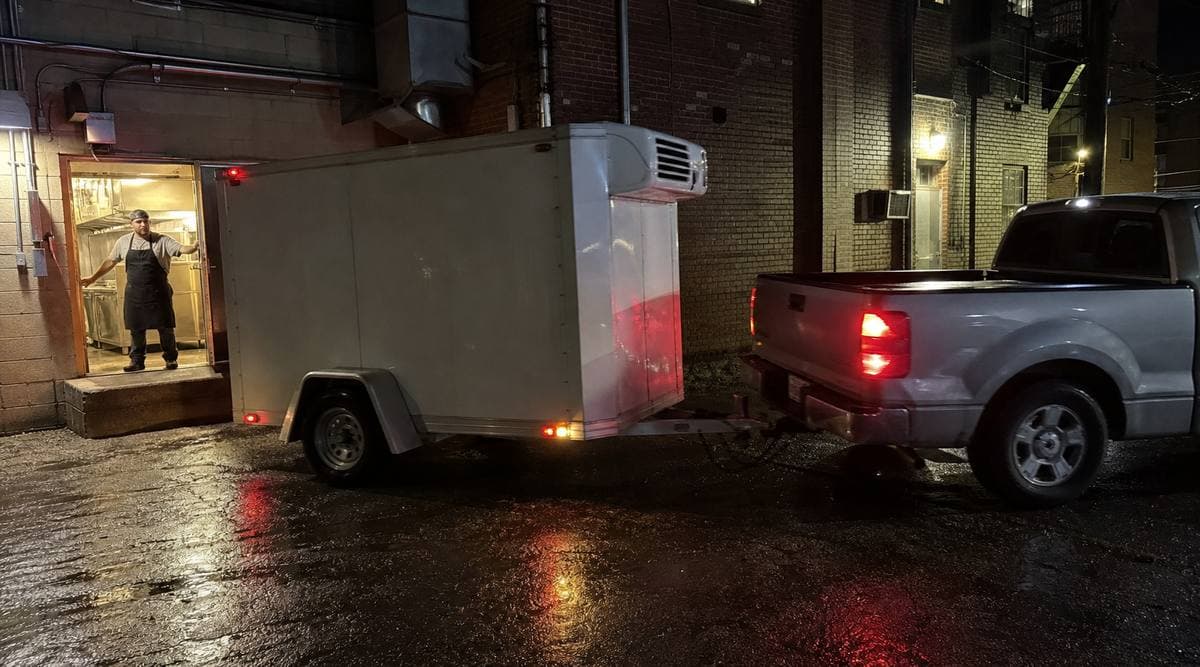
When A Refrigerated Trailer Makes Sense: Mobile Cold Storage Explained
A trailer at the back door is not a repair. It is the thing that gives the repair time. Here is what one is, how it is set up, when it fits, and how to move product into it without losing the cold chain on the way.
- 313A Licensed Mechanics
- Work By A TSSA-Registered Contractor
- WSIB Registered · Liability Insured
Published 2026-09-04
Most refrigeration failures have two problems inside them. One is the equipment, which a licensed mechanic diagnoses and repairs. The other is the product, sitting in a box that is getting warmer while that happens. Mobile cold storage exists for the second problem.
1. What A Refrigerated Trailer Is
A mobile refrigerated trailer — a reefer — is an insulated box on wheels with its own refrigeration unit. It is towed to your site, parked, powered and set to a temperature. Product goes in, the door shuts, and the trailer holds temperature independently of whatever has failed inside the building.
The refrigeration unit needs electricity from somewhere. Some trailers run on shore power, meaning a suitable electrical supply at the building. Some run on a generator, either mounted on the trailer or placed beside it. Which applies is a per-unit, per-site question that dispatch confirms on the call — the useful thing you can do is describe what electrical supply exists near the spot the trailer will sit.
Inside, a trailer is set up like a small walk-in, at one setpoint. Chilled product is held so its internal temperature stays at or below the 4°C that Ontario Regulation 493/17 requires for potentially hazardous food; frozen product is held frozen, with −18°C the working target most operators specify. Shelving goes in so product sits off the floor with air moving around it. A probe is placed at product level, away from the door and out of the unit's discharge air, and readings are logged from the moment the first product goes in.
2. The Situations It Fits
A trailer is the right answer whenever product needs somewhere cold for longer than your remaining equipment can provide. Only some of those situations are emergencies.
- A walk-in failure that needs a part. The mechanic has diagnosed a compressor, a valve, a control board or a coil, and the part is not on the truck. The box is not coming back today, and the product cannot wait.
- A planned compressor or rack replacement. Changing out a condensing unit or a rack system takes the box out of service on purpose. Cold storage lets that work be scheduled properly instead of rushed to save the stock.
- Seasonal overflow. A holiday order or a summer peak that brought in more than the walk-in holds. A packed box cannot hold temperature, so overflow into a trailer protects the product in the building too.
- An event. A catering job, a festival, a pop-up — cold storage where there is no kitchen, or more of it than the kitchen has.
- A renovation. A kitchen or backroom being rebuilt still has product to hold, and often has no working refrigeration for weeks.
What these share is a gap that is longer than a closed walk-in can bridge on its own. If the fault is something a mechanic can correct in one visit, a trailer is usually unnecessary. The walk-in cooler not cooling diagnostic helps you tell the difference before you call.
3. Where It Goes And How It Is Set Up
Placement is decided by the shortest safe route between the trailer door and the room the product is coming from — usually the loading dock, the rear laneway or the receiving door, with the trailer backed up as close as access allows. Every metre of that route is a metre product travels at ambient temperature.
The spot has to be level enough for the unit to run and drain properly, firm enough to take the weight, and clear of anything that blocks the refrigeration unit's airflow. A generator needs ventilation and distance from air intakes and doorways. In winter the path in front of the door has to be cleared and kept clear, because an icy path between a kitchen and a trailer is where product and people both get dropped.
Once parked and powered, the trailer is set to the temperature the product needs and allowed to pull down before anything goes in. Shelving is positioned, the probe is placed at product level, and the first log entry is written with the time, the reading and who took it.
4. What To Move First
Do not move everything at once, and do not move it in shelf order. Move it in order of risk.
Potentially hazardous product goes first: raw protein, dairy, cooked and ready-to-eat items, anything close to its use-by date. Small packs and thin items, which lose cold fastest, go ahead of large dense cases that hold their own cold longer. Produce and packaged goods with wide tolerance go last, and some may not need to move at all if the failed box is still close to range and the door stays shut.
Frozen product is its own decision. Goods that are still hard hold their temperature for a while in a closed freezer, and a partial thaw is often a bigger problem than a slow drift. If both a cooler and a freezer are down, say so — they are two setpoints and typically two trailers, and the freezer product may be the one that cannot wait.
5. How To Move It Without Breaking The Cold Chain
The transfer is the weakest point in the whole operation. The trailer is cold and the walk-in was cold until recently; the laneway between them is not. Every rule below serves one purpose — minimise the time each item spends between two cold spaces, and the number of times either door opens.
- Use insulated carts or covered bins. Product travels in something that holds cold, not on an open dolly. A loaded insulated cart moved once beats a dozen trips with an armful.
- Transfer in batches. Stage a full cart inside the closed box, open the door, move the cart, shut the door. Then the same at the trailer end — two short openings per batch, not a door propped open for the whole job.
- Keep both doors shut between batches. A propped trailer door dumps the cold you have just built, and a propped walk-in door warms what has not moved yet.
- Log the times. Write down when each batch left the box and when it went into the trailer, with a reading at both ends. That is the record that shows, later, that the product was never out of control.
- Load for airflow. Product off the floor, on the shelving, with space around cases and nothing stacked against the unit's discharge or return.
Once the transfer is finished, the trailer is treated like any other cold holding unit: probe at product level, readings taken on a schedule, written down and signed. The Ontario cold holding requirements do not change because the box has wheels.
6. What The Operator Has To Have Ready
Three things need to be sorted on your side before the trailer arrives.
A level spot. Decide where the trailer can sit — which dock, which side of the laneway, whether a parked vehicle or a dumpster has to move. Confirm it is somewhere a trailer can legitimately stay for the duration, not a fire route or a neighbour's space.
Access. Gate codes, a security desk, a locked yard, a loading bay with limited hours. Someone who can open the door when the trailer arrives, and a route from that door to the failed box that carts can actually travel.
A person who can sign the log. Someone on your staff owns the temperature record for as long as the trailer is on site — takes the readings, writes them down, signs them, and raises it the moment a reading is off. Without that person, the trailer is holding product nobody can account for.
7. How The Repair And The Trailer Coordinate On One Call
Cold Rescue's model is that the repair mechanics and the mobile cold storage are dispatched together, from one call, by one coordinator. The reason is practical. A mechanic who arrives at a full, warm box has to work around the product. A trailer that arrives without a diagnosis may sit unused, or arrive too late to matter. Coordinating the two means both decisions are made with the same information at the same time.
On the call, describe both problems: what the equipment is doing — the reading, how long it has been drifting, anything from the stop-and-call list — and what the product situation is — roughly what and how much is in the box, cooler or freezer, and whether you have anywhere else cold to put it. Together those decide whether the call is a repair visit, or a repair visit with a trailer behind it.
The refrigeration work is carried out by 313A licensed refrigeration and air conditioning mechanics, as a TSSA-registered contractor. The trailer holds the product in range while they do it. What happens to the product remains, throughout, the operator's decision under their own food safety plan. The mobile refrigerated storage page covers how the service is arranged.
What Operators Ask Before The Trailer Arrives
Does a refrigerated trailer need my power, or does it bring its own?
Either, depending on the unit and the site. Some trailers run on shore power — a suitable electrical supply at the building — and some run on a generator, either fitted to the trailer or placed beside it. Which one applies is confirmed by dispatch for the specific unit and the specific site, so tell the coordinator what electrical supply you have near the spot the trailer will sit, and whether there is anywhere a generator could safely run.
Can one trailer hold cooler and freezer product at the same time?
Not at the same setpoint. A trailer is one box at one temperature, so it is set for either chilled product or frozen product. If you have both, that usually means two trailers, or deciding which product is at more risk and using the trailer for that while the rest is consolidated into whatever working equipment you still have. Say what you have when you call so the right units are sent.
How long can I keep the trailer?
As long as the situation needs it — a repair waiting on a part, a planned replacement, a seasonal peak or a renovation are all different lengths, and the arrangement follows the job rather than a fixed term. What matters more than the length is that someone on your side is taking and signing off the temperature readings for the whole time it is on site, so the record is continuous from the first transfer to the last.
Who is responsible for the product while it is in the trailer?
The product decision stays with the operator throughout. The trailer provides a cold space at a known setpoint, with a probe and a log that show what that space did and when. Whether product is held, used or discarded remains a call for the operator under their own food safety plan, with the local public health unit if there is any doubt — the same as it would be in your own walk-in.
Should I call for the trailer first or the repair first?
Make one call and describe both problems: what the equipment is doing and what the product situation is. A coordinator who knows the box is warm and full can arrange the mechanic and the cold storage together, rather than sending a repair visit that finds a full box with nowhere to put anything. If the diagnosis turns out to be quick, the trailer is not needed and nothing is lost by having raised it.
If The Box Is Warm And Full, Say Both On The First Call.
Dispatch answers 24/7. Call the line directly: (416) 578-9977, or use the form below and a coordinator will call you back. Tell us what the equipment is reading and what product is in it — that is what decides whether a trailer comes with the mechanic.