Ontario Cold Holding Requirements: What Your Refrigeration Actually Has To Do
The regulation is short, specific, and about the food rather than the equipment. Here is what it says, what an inspector measures, and where equipment condition quietly decides the outcome.
Published 2026-08-30
Cold holding in Ontario is governed by Ontario Regulation 493/17 (Food Premises), made under the Health Protection and Promotion Act. It is enforced by public health inspectors from your local public health unit, and it is worth reading once, because it is shorter and blunter than most operators expect.
This page covers what the regulation actually requires of a cold holding unit, what an inspector is measuring when they open it, and the equipment conditions that decide whether you meet the requirement on an ordinary Tuesday rather than only on the day somebody checks. It is a plain-language summary, not legal advice — the regulation itself and your local public health unit are the authorities.
What the regulation actually requires
The 4°C rule is about the food, not the box
O. Reg. 493/17 requires that potentially hazardous food be distributed, maintained, stored, transported, displayed, sold and offered for sale only under conditions in which the internal temperature of the food is 4°C or lower — or 60°C or higher, if it is being hot held. The regulation allows for periods of up to two hours that are necessary for preparing, processing and manufacturing the food.
Read that carefully: the obligation attaches to the internal temperature of the food. Your refrigeration is the means, not the measure. The question an inspector is answering is not “is this unit set correctly” but “is this food at or below 4°C.”
“Potentially hazardous food” is defined in the regulation as food in a form or state that is capable of supporting the growth of infectious or toxigenic micro-organisms and which requires time and temperature control to limit that growth. In a working kitchen that is most of what sits in the walk-in.
Frozen food has to stay frozen
The regulation requires that food intended to be sold in a frozen state be kept in a frozen state until it is sold or prepared for use. It does not attach a number to that in the way it does for cold holding. −18°C is the figure the industry generally works to and the one most specifications and food safety plans are written around, but it is a standard rather than the wording of that provision. Worth knowing which is which if you are ever asked to justify a target.
The unit needs a thermometer that is accurate and readable
Equipment used for refrigeration or hot-holding of potentially hazardous food has to be of sufficient size to hold that food at the applicable temperature, and has to contain accurate indicating thermometers that may be easily read.
Three obligations are packed into one short sentence:
- Sufficient size. A unit that cannot hold what you are putting in it at temperature is not compliant merely because it is running. Overloading a box is not only an operational problem.
- Accurate. A thermometer reading three degrees low is worse than no thermometer, because it produces confident wrong readings. Calibration is not a formality.
- Easily read. Buried behind stock, fogged over, dead display, mounted where nobody can see it — all of that defeats the requirement even though hardware exists.
Equipment has to be kept in good repair
The regulation also requires that equipment used in a food premise be of sound and tight construction, kept in good repair, of a form and material that can be readily cleaned and sanitized, and suitable for its intended purpose — and that floors, walls and ceilings in food areas be kept clean and in good repair. A walk-in is both equipment and, in practice, a room. Both halves of that apply to it.
This is the provision that connects a maintenance backlog to a compliance finding. A torn gasket, a cracked interior panel, a drain pooling water on the floor and a rusted shelf are not abstract wear. They are the condition of equipment that has to be kept in good repair.
What An Inspector Is Actually Checking
In Toronto, food premises inspections run under Toronto Public Health's DineSafe programme, which inspects against O. Reg. 493/17. Every other municipality in the GTA is inspected by its own regional public health unit, running its own disclosure programme — the branding differs, the underlying regulation does not.
At a cold holding unit, the questions are concrete:
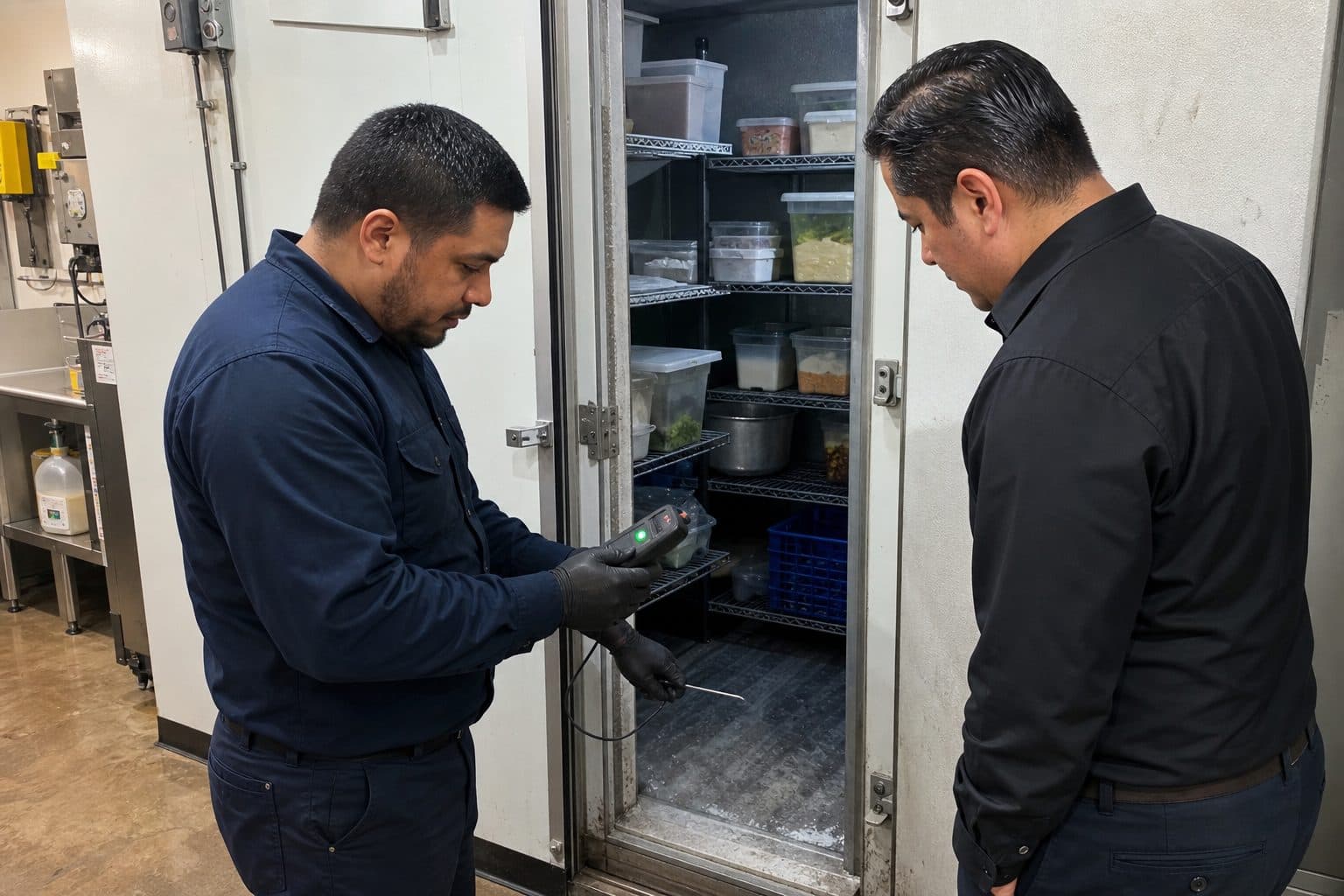
- What temperature is the food actually at, measured now, with the inspector's own probe.
- Is there a thermometer in the unit, is it readable, and does it agree with the probe.
- Is the unit holding, or is it obviously struggling — icing, pooling water, running constantly.
- Is the unit overloaded past what it can hold at temperature.
- Is it clean and in good repair — gaskets, interior surfaces, drainage, shelving.
- Is raw product stored so that it cannot contaminate ready-to-eat product.
Under DineSafe, infractions are recorded as minor, significant or crucial, and the inspection produces one of three notices: Pass, Conditional Pass, or Closed. Toronto requires every eating and drinking establishment to continually and prominently post its most recent food safety inspection notice, and Toronto Public Health publishes inspection detail online, where it is searchable and downloadable through the City's open data. The result is not a private conversation between you and the inspector. It is on your door and on the internet.
Why the setpoint is not the answer
The gap between what an operator believes a unit is doing and what an inspector measures usually opens up at the setpoint. The setpoint is an instruction. It says what you asked the equipment to do. It is not evidence that the equipment did it.
A box can sit several degrees above its setpoint for a long time without anyone noticing, because a refrigeration system can degrade gradually rather than stop outright. A gasket hardens over a season. A condenser coil loads with dust and grease and sheds capacity a little at a time. A defrost cycle stops terminating properly and the coil carries more ice each day. Airflow narrows as the box gets fuller through a busy month. None of that announces itself. The product still feels cold to a hand. The controller still displays the number it was told to hold.
The way you find out is measurement — a thermometer at product level that somebody actually reads, on a schedule, and writes down. That is also, not coincidentally, the only thing that gives you warning before the box is warm and full at 6pm on a Friday.
Temperature logs: the record you cannot reconstruct
The cold holding provisions are written around the temperature of the food, not around a prescribed log format. In practice, though, a log is how an operator demonstrates control over time — to an inspector, to a franchisor, to a third-party auditor, and above all to themselves at the moment a unit goes out of range and somebody asks how long it has been like that.
A log that is worth keeping records, at minimum:
- The unit, identified in a way everyone uses the same way — “walk-in cooler 2”, not “the big one”.
- Date and time of the reading, and who took it.
- The measured temperature — at product level, not the door display, or the display plus a periodic probe check against it.
- Whether it was in range, and if not, what was done about it and when.
- Corrective actions and service visits, so an out-of-range reading has a visible ending.
Two readings a day beats one, and readings taken at the same times each day beat readings taken whenever somebody remembers, because a pattern is what makes drift visible. The point is not the paperwork. The point is that a written record is the one thing that cannot be reconstructed after the fact. If nobody logged overnight, then nobody knows when the drift began, and every subsequent decision has to assume the worst plausible timeline rather than the true one.
What an excursion actually obliges you to decide
When a unit goes out of range, two separate decisions follow, and it helps to keep them separate.
The first is the equipment decision: what failed, whether it can be corrected now, and whether the unit can be trusted to hold temperature again. That is a refrigeration question, and a licensed mechanic answers it.
The second is the disposition decision: what happens to the food. That one belongs to the operator and their food safety plan, with the local public health unit where there is any doubt. It turns on what the product is, how far above 4°C it went, and for how long — which is why the record matters so much, and why “it was probably fine” is not a position anybody can defend for you. A refrigeration contractor can tell you precisely what the equipment was doing and when it was restored. Nobody outside your operation can make the food call.
How equipment condition turns into a compliance finding
The parts of a refrigeration system that fail slowly are the parts that produce compliance findings, because they degrade below the threshold long before anybody calls them broken.
- Door gaskets. A hardened or torn gasket lets warm humid air into the box continuously. The unit compensates by running longer, until it cannot. It is also visible damage to equipment that has to be kept in good repair.
- Drainage. A blocked condensate drain puts standing water in the pan or on the floor, and refreezes meltwater onto the coil. Standing water in a food area is a sanitation observation as well as a refrigeration one.
- Defrost. A defrost cycle that does not run, or does not terminate correctly, builds ice on the evaporator and strangles the airflow the box depends on. Box temperature climbs while everything appears to be running.
- Condenser coil condition. A coil loaded with dust and kitchen grease cannot reject heat. The system loses capacity gradually, so the box holds temperature right up until the first hot week, and then does not.
- Thermometer accuracy. The regulation asks for an accurate indicating thermometer that may be easily read. A drifting sensor or a dead display is a direct miss against that wording, and it also removes your ability to see any of the above coming.
- Interior condition. Cracked panels, damaged floors, corroded shelving — equipment that has to be of sound construction, kept in good repair, and readily cleanable.
None of these are dramatic. That is exactly the problem: they pass unnoticed on a busy day and they are all visible on a scheduled inspection, which is the practical argument for having one on the calendar rather than in the plan.
What to do when a unit is out of range right now
Work it in this order.
- Verify it with your own thermometer, at product level, in the middle of the load. Confirm you have a refrigeration problem and not a display problem.
- Write down the time and the reading, and find your last known good reading. That pair of times is the timeline everything else depends on.
- Keep the door shut. Repeatedly opening it to check costs more temperature than the check is worth.
- Work the short list of operator-checkable causes — door and gaskets, airflow and overloading, breaker, condenser, drain, defrost, thermostat. The walk-in cooler not cooling diagnostic walks that in order, and tells you where to stop.
- Call a licensed mechanic if it is anything past that list. Refrigerant work in Ontario is restricted, and an operator must not open the sealed system, add refrigerant, or bypass a safety control.
- Move or hold the product deliberately, not by default. If a repair is going to take time or a part, mobile refrigerated storage gives product somewhere in range to sit while the equipment is dealt with — which also keeps your log showing a return to compliance rather than a gap.
- Make the disposition decision against your food safety plan, and record what you decided and why. Then close the loop in the log: what failed, what was done, and when the unit came back in range.
Sources
Ontario Regulation 493/17 (Food Premises) under the Health Protection and Promotion Act, and the Ontario Ministry of Health's food premises reference document, for the cold holding, thermometer and good-repair requirements. Toronto Public Health's DineSafe programme material for the inspection notices, infraction categories, posting requirement and public disclosure. Skilled Trades Ontario for the compulsory status of the 313A trade. Where this page summarises, the regulation and your local public health unit are the authorities.
What Operators Ask About Cold Holding
What temperature does Ontario require for cold holding?
Ontario Regulation 493/17 (Food Premises), made under the Health Protection and Promotion Act, requires potentially hazardous food to be distributed, maintained, stored, transported, displayed, sold and offered for sale only under conditions in which the internal temperature of the food is 4°C or lower — or 60°C or higher for hot holding. The regulation also allows for periods of up to two hours that are necessary for preparing, processing and manufacturing the food. Note that the requirement is written about the temperature of the food, not the temperature on a controller.
Does the regulation set a specific freezer temperature?
Not a numeric one. O. Reg. 493/17 requires that food intended to be sold in a frozen state be kept in a frozen state until it is sold or prepared for use. −18°C is the figure widely used across the industry as a working target for frozen storage, and many operators and buyers write it into their own specifications — but it is a standard practice, not a number that appears in that provision. If a −18°C target applies to you, it most likely comes from your food safety plan, a customer specification, or a federal or third-party programme rather than from the provincial food premises regulation.
Does every cold holding unit need a thermometer?
O. Reg. 493/17 requires that equipment used for refrigeration or hot-holding of potentially hazardous food be of sufficient size to hold that food at the applicable temperature, and contain accurate indicating thermometers that may be easily read. Two words there do real work: accurate, and easily read. A thermometer that is buried behind stock, unreadable, or several degrees out of calibration does not satisfy the intent even though a thermometer physically exists.
Is my setpoint enough to pass an inspection?
No. A setpoint is what you have asked the equipment to do. An inspector measures what it is actually doing — the temperature of the food and of the unit at the time of the visit. A cooler set to 2°C that is holding at 7°C because of a failing gasket, a loaded condenser or a defrost fault is out of compliance regardless of what the controller says it was asked for.
Am I legally required to keep a temperature log?
The cold holding provisions in O. Reg. 493/17 are written around the temperature the food is actually at, not around a prescribed logging format. In practice a written log is how an operator demonstrates control over time, and it is commonly expected by food safety plans, franchise standards and third-party audits. If you need a definitive answer on what your specific premises must record, that question belongs to your local public health unit, who inspect against the regulation.
My cooler was above 4°C overnight. Do I have to throw the food out?
That decision belongs to the operator and their food safety plan, in consultation with the local public health unit where there is doubt. It turns on what the product is, how warm it got, and how long it was above 4°C — which is exactly why the temperature record matters, because after the fact it is the only thing that can establish the timeline. A refrigeration contractor can tell you what the equipment did and when. Nobody outside your operation can make the food disposition call for you.
Who is allowed to work on the refrigeration system itself?
Refrigeration and Air Conditioning Systems Mechanic (313A) is a compulsory trade in Ontario, so the work has to be done by a certificate of qualification holder or a registered apprentice working under one, and handling refrigerant carries its own certification requirement under Ontario's ozone-depleting substances regulation. Cold Rescue's refrigeration work is carried out by 313A licensed refrigeration and air conditioning mechanics, as a TSSA-registered contractor.
A Unit That Cannot Hold 4°C Is A Compliance Problem, Not Just A Cold One.
If a cold holding unit is drifting, get it looked at before it becomes an inspection finding. Call dispatch directly on (416) 578-9977, or use the form below — tell us what the unit is reading and how long it has been out of range.