Walk-In Cooler Not Cooling: What To Check Before You Call
Work down this list in order. Some of it you can fix in ten minutes. The rest tells you to stop, shut the door, and get a licensed mechanic on the way.
Published 2026-08-30
A walk-in that has stopped holding temperature is not always a broken walk-in. Plenty of the things that warm a box are airflow, doors and housekeeping — things a kitchen or backroom can correct without a service call. The rest is inside a sealed refrigerant system that an operator is not permitted to open in Ontario, and where the useful thing to do is stop, record what you are seeing, and call.
This page walks the two in order: what to check first, and where the line is.
1. Confirm the box is actually warm
Before anything else, find out whether you have a refrigeration problem or a measurement problem. Put a thermometer you trust into the box yourself. Not the door display — a thermometer, at product level, in the middle of the load, away from the door and out of the evaporator's discharge air.
The reason is simple. A door-mounted controller shows you whatever its sensor sees, and that sensor is in one fixed spot. It may sit in the return air stream, where the reading is warmer than the product. It may sit right under the coil, where the reading is colder than the product. It can drift out of calibration and read several degrees off for months without anyone noticing. Ontario's food premises regulation requires refrigeration equipment to contain an accurate indicating thermometer that can be easily read — a display you have learned not to believe is a compliance problem in its own right, quite apart from today's fault.
Take two readings, ten to fifteen minutes apart, and write down the times. Whether the box is holding steady at a warm temperature or still climbing is the single most useful fact you can hand a mechanic, and it changes how urgent the call is.
2. Check the door before you check anything else
The simplest way to warm a walk-in is to leave the way in open. Look for:
- A door that is not fully latching — a strike plate out of alignment, a closer that has lost its tension, or a door propped for a delivery and never closed.
- A pallet, cart, rack or box holding the door off its seal, including a curtain of plastic strips pushed permanently to one side.
- Gaskets that are torn, hardened, flattened, or pulling away at a corner. Close the door on a sheet of paper and pull: if it slides out with no resistance, that section of the gasket is not sealing. Do this at several points around the frame, especially at the bottom hinge corner where wear shows first.
- Frost or condensation on the frame or floor near the doorway, which is warm humid air finding its way in.
Gaskets are a genuine operator-fixable item and they are cheap relative to what a leaking door costs in run time. If the door is the fault, you will usually see the box recover on its own once it is sealed.
3. Check airflow inside the box
A walk-in cools by moving air. Block the air and the box warms up even though every component is working correctly.
- Nothing should be stacked against the evaporator, and nothing should be sitting in front of its discharge or return. Pallets pushed up under the unit after a delivery are easy to miss.
- Product should not be packed wall to wall or ceiling high. Air has to be able to get around the load and back to the coil.
- Boxes and film should not be covering shelving so completely that the load becomes one solid block.
- The evaporator fans should be turning. If the coil is clear of ice and a fan is stationary, that is a mechanical fault, not an airflow one — see the stop-and-call list below.
4. Ask what changed in the last day
A box that was fine yesterday and is warm today usually had something happen to it.
- A large delivery. Loading a lot of warm or ambient product at once gives the system more heat than it can pull out quickly. A box that is recovering from a load is behaving normally — it should be dropping, steadily, hour over hour. One that is flat or climbing is not.
- Someone adjusted the thermostat. Controllers get turned during cleaning, during a defrost complaint, or by a staff member trying to help. Confirm the setpoint is where it should be and that the controller is not sitting in a manual or service mode.
- A breaker tripped. Check the panel for the unit, and check whether the condensing unit and the evaporator are on separate circuits — one can be live while the other is dead. Reset a tripped breaker once. If it trips again, stop: a breaker that will not hold is telling you about an electrical fault, and repeatedly resetting it is dangerous.
- The unit is in defrost. Walk-in coolers typically defrost on a schedule, and during defrost the box temperature rises by design. If you have caught it mid-cycle, the temperature should recover within the cycle time and then keep going down. A box that never recovers after a defrost, or a unit that appears to be permanently in defrost, is a control fault.
5. Look at the condenser
The condenser is where the heat leaves the system — usually a finned coil on the roof, in a mechanical room, or on top of the box. A coil packed with dust, kitchen grease or lint cannot reject heat, so the system runs longer and colder performance falls off, often gradually enough that nobody connects it to the warm box.
- Is the coil visibly loaded with dust or greasy film, or blocked by stored items?
- Is the condenser fan running?
- Is there anything restricting the air path around the unit — stock, cardboard, snow, a closed louvre?
Clearing obstructions and stored clutter from around a condenser is fair game. Cleaning the coil itself properly is a maintenance task — it involves electrical isolation and the right chemistry, and bent fins from an over-enthusiastic clean make the problem worse. That belongs on a scheduled maintenance visit.
6. Check the drain
Water standing in the drain pan, ice building under the evaporator, or water on the floor under the coil points to a blocked or frozen condensate drain. Meltwater that cannot leave refreezes on the coil, and a coil growing ice loses the airflow it needs to cool the box. Clearing an accessible drain line is reasonable. If the drain is frozen solid, or the ice has already built up on the coil itself, treat it as mechanical.
Symptoms That Mean Stop And Call
If you see any of the following, you have moved past what an operator should be doing. Note it, shut the door, and get a mechanic on the way. Continuing to troubleshoot only spends temperature.
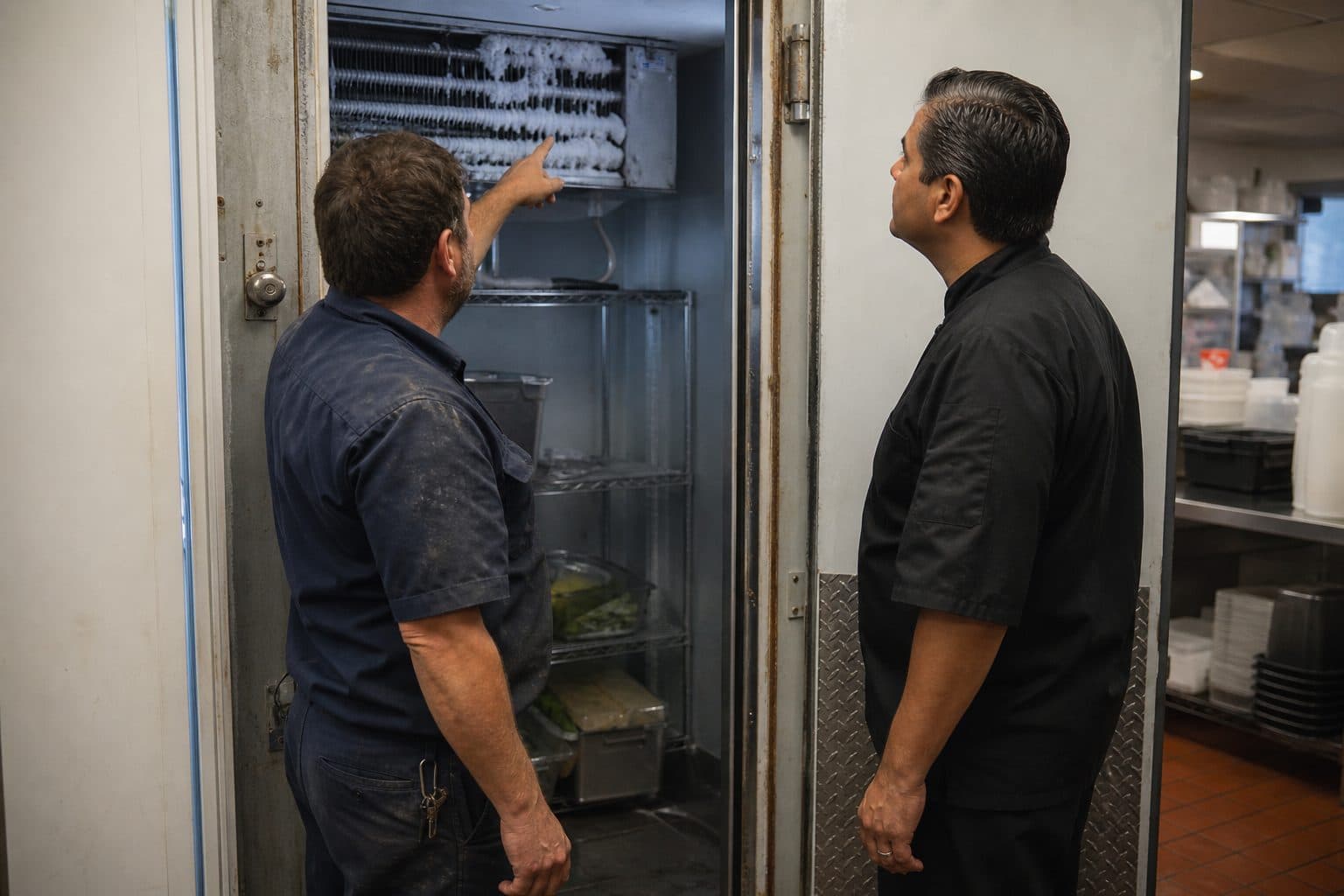
- Ice building up on the evaporator coil. A defrost, drain, airflow or charge fault. Melting it clears the symptom and not the cause, and chipping at it punctures the coil.
- A compressor that will not start, or that hums, buzzes and stops.
- Short-cycling — the compressor starting and stopping every few minutes instead of running through a proper cycle.
- Hissing, gurgling or bubbling from the lines or the valve.
- Oil residue around fittings, valves or joints. Refrigerant carries oil, so an oily film or a dirt-caked wet patch at a joint is a likely leak point.
- A fan motor that is not turning — at the condenser or on the evaporator — when the unit is calling for cooling.
- Heavy frost on the suction line running back to the condensing unit.
- Burning smells, scorched terminals, or a breaker that trips again after one reset. Leave it off and treat it as an electrical fault.
The line you must not cross
Everything above stops at the outside of the machine. In Ontario, Refrigeration and Air Conditioning Systems Mechanic (313A) is a compulsory trade: to work in it legally a person has to hold a certificate of qualification, a provisional certificate, or a registered training agreement as an apprentice working under one. Handling refrigerant carries its own certification requirement under Ontario's ozone-depleting substances regulation.
So, plainly — an operator or a general handyperson must not:
- open the sealed refrigerant system, connect gauges, or braze anything;
- add, recover or vent refrigerant;
- bypass, jumper or disable a safety control — a high-pressure cut-out, a low-pressure switch, a defrost termination, a door switch;
- force a contactor closed to “get it running” while somebody looks for a part.
The reasons are not only legal. A system low on charge is low because it is leaking, and adding gas without finding the leak vents it straight back out and leaves the compressor running starved, which is what destroys compressors. A bypassed safety control is a control that was protecting something. And an undocumented refrigerant intervention makes the eventual real diagnosis slower and more expensive, because the mechanic now has to work out what the system is actually doing and what somebody did to it.
Cold Rescue's refrigeration work is carried out by 313A licensed refrigeration and air conditioning mechanics, as a TSSA-registered contractor. Ask any contractor to produce both — on this call or any other.
What to do with the product while you decide
The product decision is separate from the repair decision, and it is yours. A few practical things hold regardless of what the fault turns out to be.
- Keep the door shut. Every open-door cycle replaces cold air with warm humid air, and a box with no cooling has no way to recover it. Repeatedly opening the door to check the temperature is one of the fastest ways to lose the product you are checking on.
- Read the temperature without opening. If you have a probe or a wireless sensor already in the box, use it. If not, take one reading, thoroughly, and then leave it alone.
- Find out when the drift started. Your temperature log is the only thing that can tell you this after the fact, and it is what turns “the cooler is warm” into a defensible timeline. If nobody logged overnight, be honest with yourself about the earliest time the box could have gone out of range, not the most convenient one.
- Understand what actually matters. Ontario Regulation 493/17 requires potentially hazardous food to be kept at an internal temperature of 4°C or lower. The measure that counts is time above 4°C, not how the box looks or how the product feels.
- Make the disposition call against your food safety plan. Whether product is held, used, or discarded is the operator's decision under their own food safety plan, with their local public health unit if there is any doubt. A refrigeration contractor can tell you what the equipment did and when. Nobody outside your operation can make the food call for you.
- Have a plan for capacity, not just for repair. If a diagnosis is going to take time or a part, product needs somewhere cold to be in the meantime. That is what mobile refrigerated storage is for, and it is worth raising on the first call rather than the third.
What to have ready when you call
A dispatcher can scope the call far better with six pieces of information. Gather them before you dial and the conversation takes two minutes instead of ten.
- Address and access. The site address, which door or dock to come to, and anything a technician needs to get in — a gate code, a loading bay, a security desk, a roof hatch key, whether the mechanical room is locked and who holds the key.
- What the equipment is. Walk-in cooler or freezer, reach-in, rack system, prep table, display case. Rough size of the box. If you can reach the data plate on the condensing unit safely, the make and model number save real diagnostic time.
- What it is reading now. The current temperature, taken with a thermometer you trust, and the setpoint it is supposed to be at.
- How long it has been drifting. When the last known good reading was, and whether the box is holding steady or still climbing.
- What you already checked. Door and gaskets, airflow, breaker, condenser, drain — and anything on the stop-and-call list that you saw.
- Whether the product is still cold, roughly what and how much is in the box, and whether you have anywhere else to put it.
If the box is already well out of range and full, say so at the start of the call. That is the difference between a repair visit and a repair visit with cold storage behind it.
Related: the walk-in cooler emergency checklist covers the first fifteen minutes once you have confirmed a real failure, and equipment we service lists the systems this applies to.
Questions Operators Ask With A Warm Box In Front Of Them
The box is reading 8°C. How long do I have?
There is no single answer, and anyone who gives you one without seeing the box is guessing. It depends on what the product is, how long it has already been drifting, and what your food safety plan says. What matters for the food safety decision is time above 4°C — Ontario Regulation 493/17 requires potentially hazardous food to be held at an internal temperature of 4°C or lower. Check your temperature log to find out when the drift actually started, keep the door shut, and make the disposition call against your own food safety plan or your local public health unit's guidance.
The door display says 2°C but the product feels warm. Which one do I believe?
Believe a thermometer you have put in the box yourself, at product level, away from the door and away from the evaporator discharge. A door-mounted controller reads the sensor it is wired to, and that sensor can be in the return air stream, badly positioned, drifting out of calibration, or reading a spot that is genuinely colder than the rest of the box. A controller showing a number that the product does not agree with is itself a fault worth reporting.
Can I top up the refrigerant myself if the charge is low?
No. Refrigeration and Air Conditioning Systems Mechanic (313A) is a compulsory trade in Ontario, so the work has to be done by a certificate holder or a registered apprentice working under one, and handling refrigerant additionally requires certification under Ontario's ozone-depleting substances rules. Beyond the legal position, a system that is low on refrigerant is low because it is leaking. Adding gas without finding the leak vents it again and leaves the compressor running in the same starved condition that damages it.
There is ice all over the evaporator coil. Can I just melt it off and carry on?
Melting the ice will usually get the box cold again for a while, and it does not fix anything. A coil that ices over has an underlying cause — a defrost cycle that is not running or not terminating, a failed defrost heater or timer, a blocked drain refreezing meltwater, restricted airflow, or a low charge. If you thaw it and it ices again, you have confirmed a mechanical fault rather than solved one. Never chip ice off a coil with a tool: the fins and the tubing behind them puncture easily, and a punctured coil turns a service call into a coil replacement.
The compressor keeps starting and stopping every few minutes. Is that normal?
Short-cycling is not normal running behaviour and it is hard on the compressor. It can come from a control or pressure switch problem, a refrigerant charge issue, a restricted condenser, or an electrical fault. It is a stop-and-call symptom rather than something to keep watching. Note when it started and roughly how often it cycles — that detail is genuinely useful to the mechanic before they arrive.
Should I move product out before a technician gets there?
Only if you have somewhere genuinely colder to put it. Moving product into a second unit that is already full, or onto a prep bench while you decide, usually costs you more temperature than leaving it in a closed box that is drifting slowly. If you have working reach-ins or a second walk-in with real capacity, move the highest-risk items first — dairy, raw protein, and anything close to its use-by date. If you do not, keep the door shut and call.
If The Box Is Still Warm, Make The Call Now.
Dispatch answers 24/7. Call the line directly: (416) 578-9977, or use the form below and a coordinator will call you back. Tell us what it is reading and how long it has been drifting — that is what decides what we send.