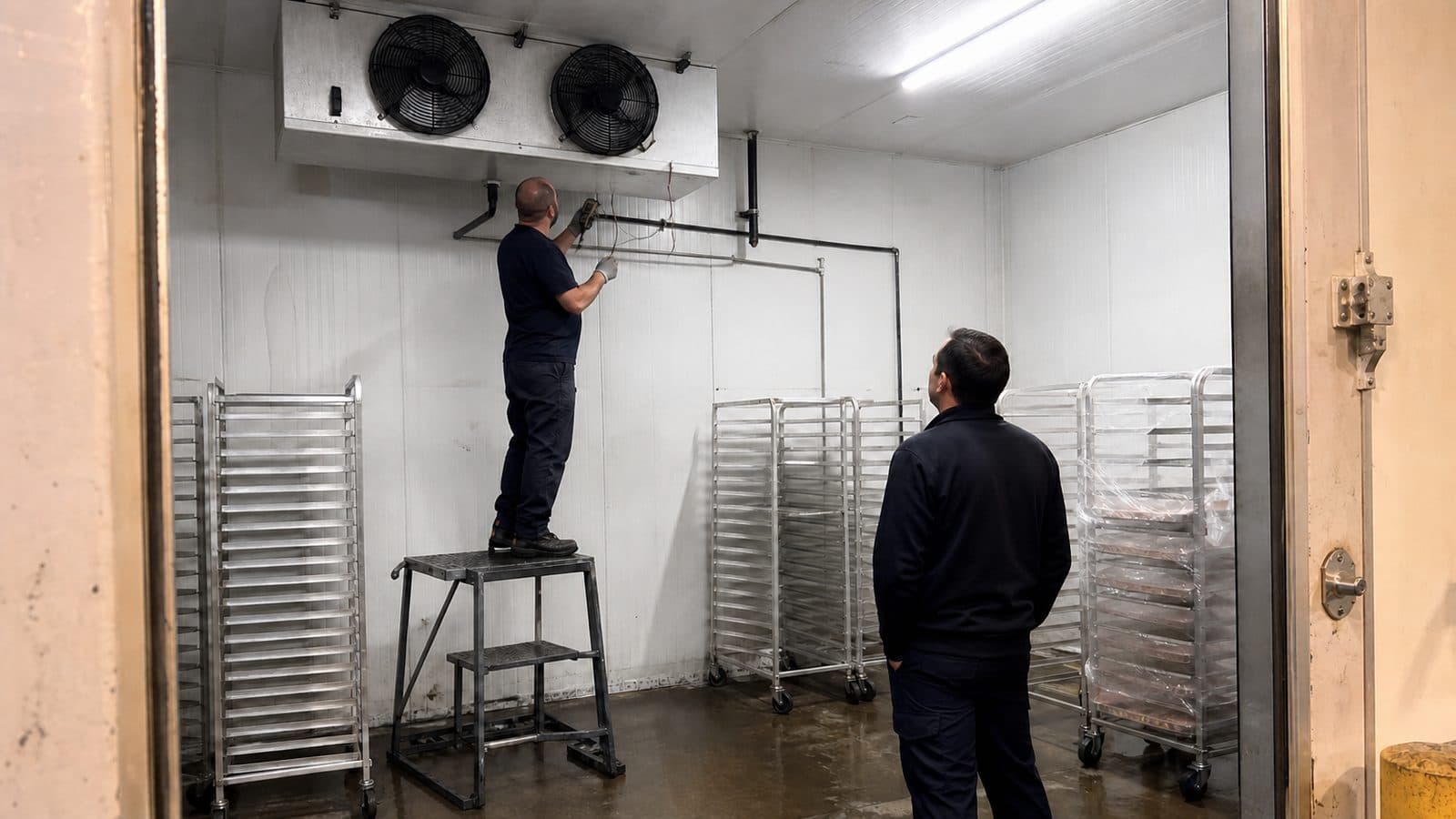
The Commercial Refrigeration Maintenance Checklist Managers Can Actually Run
What your own staff can do every day, week and month to keep coolers and freezers holding temperature — and the line past which the work belongs to a licensed mechanic.
- 313A Licensed Mechanics
- Work By A TSSA-Registered Contractor
- WSIB Registered · Liability Insured
Published 2026-09-04
Most commercial refrigeration failures do not arrive out of nowhere. They are the end of a slow decline that a kitchen or a store floor could have seen coming — a gasket that hardened over a season, a drain that started pooling, a condenser that loaded up with grease through a busy summer. None of it needs a mechanic to spot. It needs somebody looking.
This checklist splits the work into what your own staff can do on a daily, weekly and monthly rhythm, what must be left to a licensed mechanic, and what a proper preventive-maintenance visit should cover. It is written for walk-ins, but nearly all of it applies to reach-ins, prep tables and display cases too.
1. Daily: Log Temperature At Product Level
The daily job is one job. Read the temperature with a thermometer you trust, placed at product level in the middle of the load, and write it down. Not the door display — a controller shows you what its one sensor sees, and that sensor may sit in the return air, under the coil, or several degrees out of calibration.
Take the reading at the same times each day, and take it without holding the door open. Ontario Regulation 493/17 requires potentially hazardous food to be held at an internal temperature of 4°C or lower, and it requires the unit to contain an accurate, easily read thermometer. A log that is taken consistently is what makes a slow drift visible while there is still time to do something about it. The Ontario cold holding guide covers what the regulation says and what an inspector actually measures.
2. Weekly: Doors, Gaskets And Closers
The door is where most of the warm air gets in, and it wears faster than anything else on the box. Once a week, check it properly.
- Close the door on a strip of paper and pull. If the paper slides out freely, that section of gasket is not sealing. Test several points around the frame, especially the bottom hinge corner.
- Look for gaskets that are torn, hardened, flattened or pulling out of their channel. Wipe them down — a gasket caked in dried spills does not seal and cracks sooner.
- Let the door go from half open. A closer that has lost its tension leaves the door resting against the frame instead of latching, and nobody notices until the box is warm.
- Check the strike plate, the latch and any strip curtain. A curtain permanently pushed to one side is not doing its job.
Gaskets are a legitimate operator-serviced part. If your staff cannot fit them, put the request on the next maintenance visit rather than living with the leak.
3. Weekly: Keep The Air Moving
A cooler cools by moving air across a coil and around the load. Anything that stops the air stops the cooling, even when every component is working correctly.
Inside the box, nothing should be stacked against the evaporator or in front of its discharge and return. Product should sit on shelving, not on the floor, and it should not be packed wall to wall or ceiling high. Cases pushed up under the evaporator after a delivery are an easy airflow fault to miss, and they are corrected in a minute.
At the condenser — on the roof, in a mechanical room, or on top of the box — the job is clearance. Move stock, cardboard, pallets and anything else restricting the air path, and confirm the condenser fan is turning when the unit is running. Look at the coil: a visible film of dust, grease or lint means it is losing capacity, and that gets reported for cleaning. Cleaning the coil itself is not a staff job, for reasons covered below.
4. Monthly: Drains, Pans, Defrost And Ice
Once a month, spend a few minutes looking at where the water goes. Every defrost produces meltwater, and it has to leave the box through the drain pan and the drain line. When it cannot, it refreezes on the coil, and a coil carrying ice loses the airflow the box depends on.
- Look for standing water in the drain pan, ice forming under the evaporator, or water on the floor beneath the coil. All three point to a slow or blocked drain.
- Check that the drain line runs downhill with no sag, that its outlet is clear, and that it is not frozen where it passes through a freezer wall. Clearing an accessible line of debris is reasonable; a drain frozen solid is a service item.
- Watch one defrost cycle. The coil should clear completely and the box should recover within the cycle. A coil that never fully clears, or a unit that seems to be permanently in defrost, is a control fault.
- Compare ice build-up month to month. Light, even frost that clears on defrost is normal. Ice that is thickening, uneven, or spreading onto the fan guards is not.
Never chip ice off a coil with a tool. The fins and the tubing behind them puncture easily, and a punctured coil turns a maintenance item into a coil replacement.
5. Every Visit: Listen To The Compressor And Walk The Outdoor Unit
Whoever is doing the weekly checks should also stand next to the condensing unit for a minute and listen. You are not diagnosing anything — you are learning what normal sounds like so that abnormal is obvious. A compressor that starts and stops every few minutes, hums or buzzes without starting, rattles, or runs continuously without the box ever reaching setpoint is a stop-and-call finding, not a watch-and-wait one.
For rooftop and outdoor units, add the surroundings to the walk. Leaves, litter and cottonwood fluff in summer, snow and ice in winter, and stored items year-round all choke the air the condenser needs. Keep a clear space around the unit. Note any oily residue at fittings or joints while you are there — refrigerant carries oil, and an oily patch is a likely leak point that needs a mechanic, not a wipe.
6. What Must Be Left To A Licensed 313A Mechanic
Everything above happens on the outside of the machine. In Ontario, Refrigeration and Air Conditioning Systems Mechanic (313A) is a compulsory trade: the work has to be done by a certificate of qualification holder or a registered apprentice working under one. Handling refrigerant carries a further certification requirement under the province's ozone-depleting substances rules. So, plainly, your staff must not:
Open the sealed refrigerant circuit, connect gauges, add or recover refrigerant, or braze anything. Work on electrical faults beyond resetting a breaker once — a breaker that trips again is telling you something, and repeatedly resetting it is dangerous. Bypass or jumper any safety control. And chemically clean a condenser coil, which requires electrical isolation, the right cleaner for the coil material, and a technique that does not bend the fins. Ask any contractor you use to show their 313A certification and TSSA registration; Cold Rescue's refrigeration work is carried out by 313A licensed mechanics as a TSSA-registered contractor.
The line is not only legal. A system low on refrigerant is leaking, and topping it up without finding the leak leaves the compressor running starved. If your checklist turns up anything on the mechanical side, the walk-in cooler not cooling guide sets out where an operator stops and a mechanic starts.
7. What A Preventive-Maintenance Visit Should Cover, And The Records To Keep
A professional visit picks up where your staff leave off. Expect the mechanic to clean the condenser and evaporator coils properly, check the refrigerant charge and look for leaks, inspect and tighten electrical connections and test the contactors and controls, check the compressor's running behaviour, verify the defrost schedule and termination, test the fan motors, flush the drain line and inspect the pan and any drain heater, check the door hardware and gaskets, and calibrate the thermometer against a known reference. You should get a written report of what was found, what was corrected, and what is likely to need attention next. That is what a scheduled preventive-maintenance visit is built around.
Keep your own records alongside it. One binder or folder per unit, identified the way everyone uses the same way — “walk-in freezer 1”, not “the back one”. In it: the daily temperature log with the time and the initials of whoever took the reading; the weekly and monthly checklist sheets, signed and dated; any out-of-range reading with what was done about it and when the unit came back in range; every service report; and the make, model and serial number from the data plate.
That record does two jobs at once. For a public health inspection, it demonstrates control over time rather than a single good reading on the day. For a service call, it tells the mechanic what the unit has been doing, what was already checked, and what was last replaced — which shortens the diagnosis.
What Managers Ask About Looking After Refrigeration
How often should a commercial refrigeration unit be professionally serviced?
It depends on the equipment, the environment and how hard it works. A walk-in in a hot, greasy kitchen with a rooftop condenser needs more attention than a reach-in in a cool back office, and a unit that carries the whole operation's raw protein deserves more than one that holds drinks. The practical answer is to set a schedule with a licensed contractor based on your equipment and stick to it, and to time at least one visit ahead of summer, when condensers are under the most strain.
Can my staff clean the condenser coil themselves?
Staff can and should keep the area around the condenser clear of stock, cardboard, snow and debris, and can report a coil that is visibly loaded with dust or grease. Cleaning the coil itself is a job for the maintenance visit. It involves electrically isolating the unit, using the right coil cleaner for the coil material, and rinsing without bending the fins — a coil brushed enthusiastically with the wrong tool ends up rejecting less heat than it did before it was cleaned.
What is the single most useful thing a manager can do for refrigeration?
Take a real temperature reading at product level, at the same times every day, and write it down. Almost every refrigeration failure that ends in lost product was drifting for days before anyone noticed, and a consistent log is the only tool that makes slow drift visible. It also gives you the timeline you need for the food safety decision if a unit does go out of range.
Is it worth having a maintenance plan if the equipment is new?
New equipment is the cheapest equipment to look after, because the visit is confirming that nothing has started to go wrong rather than catching up on years of neglect. Gaskets, drains, condenser coils and defrost settings deteriorate from the day the unit is commissioned, regardless of its age. A schedule set up early also produces the service history that a future service call, auditor or equipment buyer will ask to see.
What should I do if the checklist turns up something I cannot fix?
Write down what you saw, when you saw it, and what the unit was reading at the time, and then call a licensed mechanic rather than working around it. Ice building on the coil, a compressor that short-cycles or hums without starting, a breaker that trips again after one reset, or any sign of a refrigerant leak are stop-and-call findings, not watch-and-wait ones. The walk-in cooler not cooling guide on this site walks through where the line sits.
The Checklist Catches It Early. A Mechanic Fixes It Before It Fails.
If your checks have turned something up, or you want a licensed mechanic on a schedule rather than on an emergency call, contact dispatch on (416) 578-9977 or use the form below. Tell us what equipment you run and what your staff have been seeing.