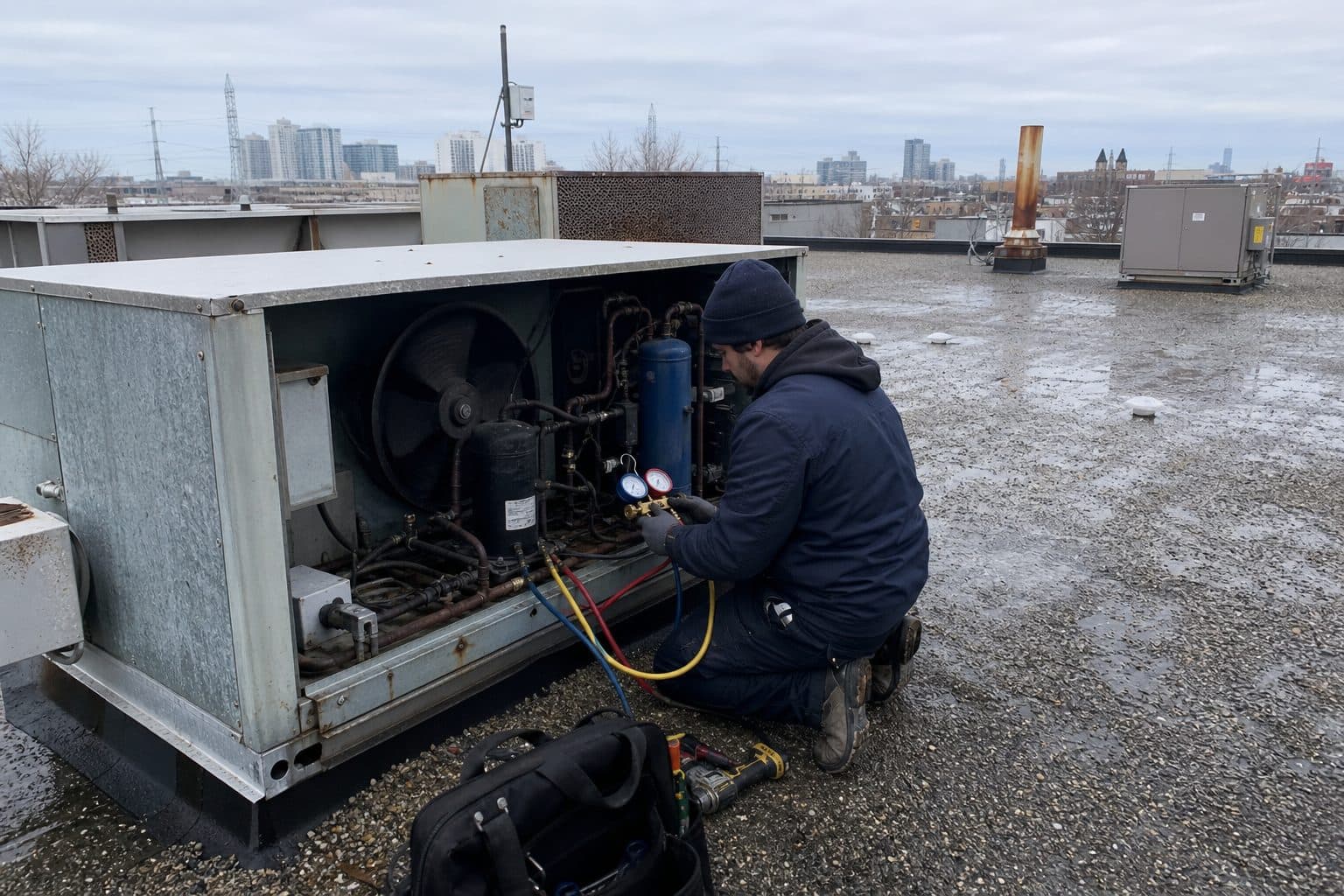
Keeping Commercial Refrigeration Alive Through A Toronto Heat Wave
Hot, humid weather is the hardest thing a condensing unit faces all year. Here is why, what you can do about it before and during a hot spell, and the signs that a unit has stopped keeping up.
- 313A Licensed Mechanics
- Work By A TSSA-Registered Contractor
- WSIB Registered · Liability Insured
Published 2026-09-04
Most commercial refrigeration failures in Toronto do not happen in January. They happen on the hottest, stickiest weekend of the summer, when every unit in the city is working at the top of its range and the ones with a weakness underneath find it. A condenser that was marginal in May becomes a warm box in July.
This page explains why heat does that, what an operator can genuinely do to help a unit through it, and where the line is between helping and making things worse. It pairs with our guide on what to check when a walk-in stops cooling.
1. Why Heat And Humidity Push A Condensing Unit Past Its Limit
A refrigeration system moves heat from inside the box to the air outside it. The condenser is where that heat leaves, and it can only leave if the outdoor air is cooler than the refrigerant in the coil. As the air around the condenser gets hotter, the refrigerant has to be compressed to a higher pressure before it will give up its heat. Discharge pressure rises, the compressor works harder and draws more current, and the system's capacity falls — at the same time the box is gaining more heat through its walls and door.
Humidity adds a second load. Every time a door opens, warm moist air enters and its water vapour freezes on the evaporator. That frost has to be removed by defrost, and defrost is heat added to the box. On a humid day a unit spends more of its time defrosting and recovering, and less of it holding temperature.
Where the unit sits decides how bad this gets. A rooftop condenser stands on dark roofing in direct sun, often next to other condensers and exhaust fans blowing hot discharge air into its intake. A back-alley unit is worse: boxed in by walls, a dumpster and a kitchen hood exhaust, with nowhere for the hot air to go except back through the coil. Both are running in air considerably hotter than the forecast says.
2. Before The Heat Arrives: Get The Condenser Ready
The most useful thing an operator can do for summer is to have the condenser coils cleaned by a licensed mechanic before the first hot spell, not after it. A coil fouled with a season of dust, pollen, cottonwood fluff and kitchen grease cannot reject heat properly on a mild day. On a hot one it cannot reject enough at all.
That clean is a mechanic's job rather than a staff job. Done properly it involves isolating the power, the right cleaning chemistry for the coil, and rinsing so the dirt comes out instead of being packed deeper in. A pressure washer or a stiff brush in the wrong hands flattens fins and makes the restriction permanent. The same visit is the time to have the condenser fan motors, contactors and controls checked — a fan turning slowly on a mild day will stall on a hot one. That is what a preventive maintenance visit is for, and spring is when to book it.
3. Clear The Air Around The Unit
Cleaning the coil helps only if air can get to it. Walk to every condensing unit you have — roof, alley, mechanical room, on top of the box — and look at what is around it.
- Nothing stacked against or on top of the unit: stock, cardboard, pallets, patio furniture, discarded equipment.
- Clear space on every side meant to be open, so the hot air the fan throws out is not pulled straight back into the coil.
- No kitchen hood exhaust, dryer vent or another unit's discharge blowing into the intake. If there is, talk to a mechanic about relocating or shielding it.
- Fins and grilles free of leaves, plastic bags and anything the wind has pinned to them. A bag over a corner of the coil is a surprisingly common cause of a warm box.
4. During The Hot Spell: Door Discipline And Loading
Once the heat is here, most of what you control is how much heat you let into the box. A unit that has lost some capacity to the weather can still hold temperature if the load on it is kept sensible.
- Fewer, shorter door openings. Batch trips into the walk-in rather than making a dozen small ones, and never prop the door for a delivery in the afternoon heat.
- Strip curtains in place and hanging properly, not tied back or missing half their strips. On a humid day they are the difference between a unit that keeps up and one that ices over.
- Do not overload. A large warm delivery packed to the ceiling gives the system more heat than it can remove and blocks the airflow it needs to remove any of it. Stage deliveries and leave air space around the load.
- Cool hot food before it goes in, and check gaskets. Warm humid air past a tired gasket shows up as condensation and frost around the door frame, and as run time you are paying for.
5. Check The Drains And Log The Temperatures
More defrost means more meltwater, and a condensate drain that copes in April may not cope in July. Look under the evaporator for standing water in the pan, water on the floor, or ice building beneath the coil. Meltwater that cannot leave refreezes on the coil, and an iced coil loses the airflow it needs. Clearing an accessible drain line is reasonable; a coil already carrying ice is a call.
Then log temperatures more often than you normally do, at product level rather than off the door display. Ontario Regulation 493/17 requires potentially hazardous food to be held at an internal temperature of 4°C or lower, and on a hot week the log is what tells you a box is drifting before it is out of range rather than after. A reading that creeps upward every afternoon is a unit running at its limit — and exactly the detail a mechanic wants to hear. Our guide to Ontario cold holding requirements covers what the regulation expects of the log and the thermometer.
6. The Symptoms That Mean The Unit Is Losing The Fight
An operator cannot read discharge pressure without gauges, and connecting gauges is licensed work. But rising head pressure has symptoms you can see and feel from outside the machine, and they are the signals to act on.
- The unit never cycles off. Continuous running while the box temperature holds flat or climbs means the system has run out of capacity.
- Warm air off the condenser, or no air at all. Air leaving the condenser should be noticeably warm — that is the heat leaving. A coil hot to the touch with a fan stalled or barely turning means heat is not being rejected.
- Tripping on high pressure. A high-pressure cut-out that drops the unit out, and again after a reset, is the system protecting the compressor from exactly the condition heat creates. Do not keep resetting it and never bypass it.
- The compressor sounds laboured, or the breaker trips — often in the late afternoon when the roof is hottest and the compressor is drawing the most current. Reset a breaker once. If it trips again, leave it off.
- The box recovers overnight and loses it again by mid-afternoon, day after day. That pattern is the unit telling you its margin is gone.
Any of these is a stop-and-call symptom. Note the time, the box temperature and what you saw at the condenser, shut the door, and get a licensed mechanic on the way. The fault may be a loaded coil, a failed fan motor, a contactor or a charge problem — none of which an operator can resolve, and all of which get more expensive the longer a compressor runs against them. That is what our emergency refrigeration repair service is for.
7. Plan Cold-Storage Backup For The Busiest Weekends
Heat waves and peak trade arrive together. The long weekend, the patio crowd, the catering job you have been building towards — all of them land on the days your refrigeration is least able to cope, and the days every mechanic and rental unit in the city is already spoken for.
Planning for that mostly means deciding things in advance. Know which units carry your highest-risk product and where it would go if one failed on a Saturday. Know whether your reach-ins have any real spare capacity when they are full for service. And know what a refrigerated trailer or container needs on site — a flat spot, a power supply if it is electric, and access for delivery.
For a known peak weekend in a hot forecast, arranging mobile cold storage ahead of time as overflow, rather than as a rescue, takes the weather out of the equation. It is also worth raising on the first call when a unit does fail: if the diagnosis is going to take a part, the product needs somewhere cold to be while it does.
A walk-in that struggles every summer is a walk-in with a problem, and the fix is a conversation with a mechanic in the spring, not a better plan for July.
What Operators Ask When The Forecast Turns Hot
Can I hose down the condenser coil myself during a heat wave?
Clearing leaves, cardboard and stored stock from around the unit is fair game, and so is brushing loose debris off the face of the coil with the power off. A proper coil clean is a different job: it involves electrical isolation, the right cleaning chemistry for the fin material, and rinsing from the correct direction so the dirt comes out rather than being driven deeper into the coil. Bent fins from a pressure washer or a stiff brush restrict airflow permanently. Leave the wet clean to a licensed mechanic and book it before the heat arrives rather than during it.
Is it normal for the unit to run all day when it is hot out?
Longer run times in hot weather are expected, because the system has less capacity and the box has more heat coming in. What is not normal is a unit that never cycles off at all, or one that runs continuously while the box temperature climbs. That combination means the system is no longer keeping up, and the question becomes why — a loaded condenser, a fan problem, a charge issue, or simply more ambient heat than the unit was sized for. Log it and call rather than waiting to see whether the evening cools it down.
Should I turn the setpoint down to get ahead of the heat?
Usually not. A lower setpoint asks a unit that is already struggling to reach a temperature it may not be able to hit, so it runs longer, rejects heat less efficiently, and gains nothing at product level. The better use of your effort is reducing the heat getting into the box — door discipline, not overloading with warm product, clear airflow — and making sure the condenser can reject what it does have. If the box will not hold its normal setpoint in the heat, that is a fault to report, not a number to chase.
The high-pressure switch tripped and I reset it. Can I keep doing that?
No. A high-pressure cut-out is a safety control, and it tripped because discharge pressure rose past the point the system is designed to tolerate. One reset to confirm the trip is reasonable. Repeated resets keep pushing the compressor into a condition that is damaging it, and each trip is telling you the same thing about heat rejection. Bypassing or jumpering the switch is not permitted and is exactly the kind of intervention that turns a serviceable unit into a compressor replacement.
When should I book mobile cold storage rather than just calling for a repair?
As soon as you can see that a repair might not be finished before the product is at risk, or before a busy weekend you cannot afford to lose. On a hot weekend, both refrigeration mechanics and rental cold storage are in demand across the city, and a unit that goes down on Friday afternoon is competing with every other unit that did the same thing. Raising cold storage on the first call, or arranging it in advance for a known peak, is far easier than arranging it once the box is already warm.
If The Unit Is Running Flat Out And The Box Is Still Climbing, Call Now.
Dispatch answers 24/7. Call the line directly: (416) 578-9977, or use the form below and a coordinator will call you back. Tell us what the box is reading, what you saw at the condenser, and whether you need cold storage behind the repair.